

Descale Tankless

Tankless Water Heater Descaling Procedure
Can I Descale My Own Tankless Water Heater?
Another common question we’re asked at Barry Williams Plumbing is:
“Can I descale my own tankless water heater?”
The answer is YES! This maintenance procedure is a little more involved than flushing a conventional tank water heater, but if you’re handy and comfortable working with plumbing connections, you may be able to do it yourself.
However, it’s important to follow the instructions for your particular water heater. Procedures vary between manufacturers and models.
Why Is Descaling Important?
As water passes through a tankless water heater, minerals can accumulate inside the heat exchanger. Over time, this buildup can restrict water flow, reduce heating performance, and contribute to premature equipment failure.
Regular descaling helps remove mineral deposits and maintain efficient operation.
What You’ll Need
- Manufacturer-approved descaling solution, or white distilled vinegar if permitted by your water heater manufacturer.
- One five-gallon bucket.
- One small submersible utility pump suitable for the cleaning solution.
- Two washing machine-style hoses compatible with your service connections.
- Your water heater’s maintenance instructions.
Before You Begin
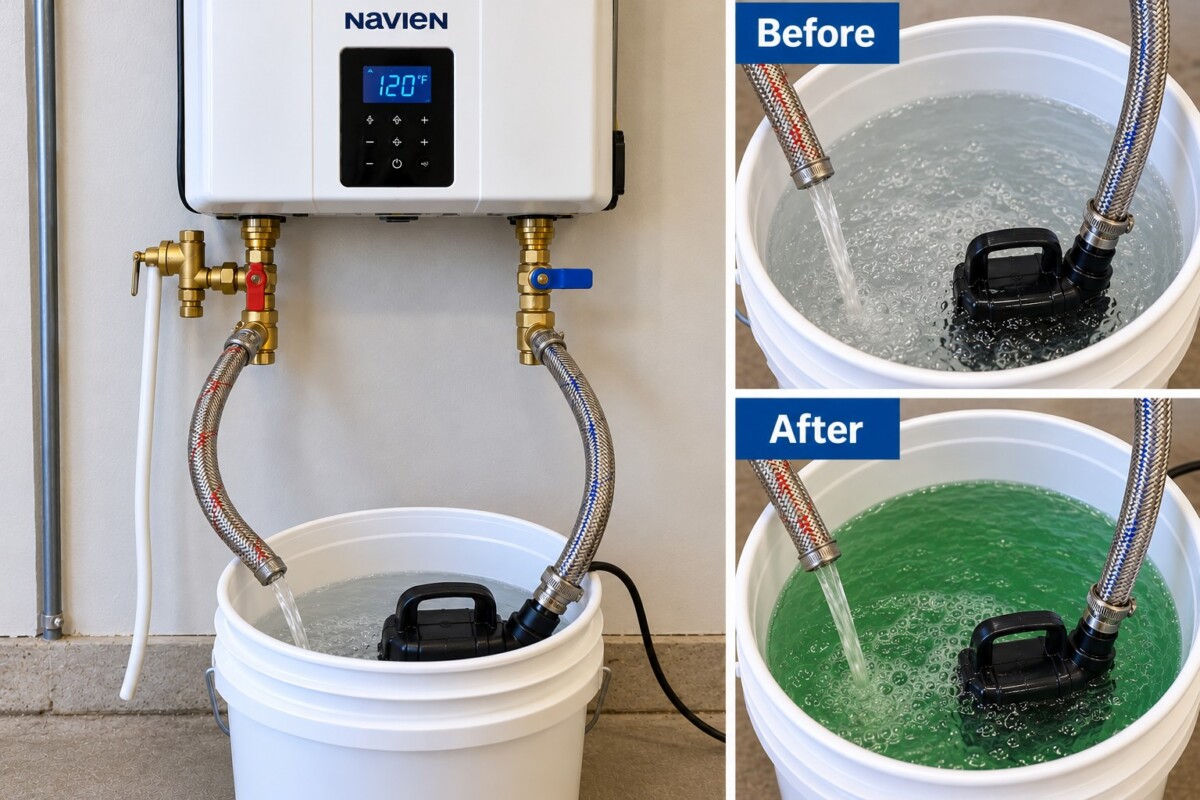
The photograph shows a typical set of tankless water heater isolation and service valves.
Before purchasing supplies, make sure your water heater has properly installed service valves. These valves allow the heat exchanger to be isolated from your home’s plumbing system and connected to a cleaning pump.
If your heater doesn’t have service valves, contact Barry Williams Plumbing about having them installed.
Before proceeding, consult your water heater manufacturer’s descaling instructions. Do not assume that all models use the same cleaning solution, circulation time, or valve sequence.
How to Descale a Tankless Water Heater
The following is a general overview for a gas-fired tankless water heater equipped with standard isolation and service valves. Follow the manufacturer’s specific procedure whenever it differs.
- Shut down the water heater. Turn off the heating operation, electrical power, and gas supply as directed by the manufacturer.
- Close the hot- and cold-water isolation valves to separate the heater from the home’s plumbing system.
- Remove the service port caps. Be prepared for residual water and pressure. Follow the manufacturer’s instructions for relieving pressure safely.
- Connect the first hose between the pump outlet and the cold-water service port.
- Connect the second hose between the hot-water service port and the bucket.
- Open the service valves as directed by the manufacturer.
- Drain any residual water as required by the manufacturer’s procedure and dispose of it appropriately.
- Prepare the cleaning solution. Place the pump in the bucket and add the manufacturer’s recommended quantity of approved descaling solution. If vinegar is permitted, use the specified amount and concentration.
- Start the pump and circulate the solution through the heat exchanger for the period specified by the manufacturer. Check periodically for leaks and proper circulation.
- Stop the pump when the recommended cleaning cycle is complete. Dispose of the used cleaning solution according to its instructions.
- Flush the heat exchanger with clean water using the valve sequence and flushing duration specified by the manufacturer. Keep the discharge directed safely into the bucket or an appropriate drain.
- Flush thoroughly! You want to remove the cleaning solution before returning the heater to service. Otherwise, your next cup of coffee might have an unexpected flavor! 😂
- Close the service valves, disconnect the hoses, and reinstall the service port caps. Make sure all connections are secure.
- Reopen the hot- and cold-water isolation valves in the sequence specified by the manufacturer. Check for leaks.
- Restore power and gas according to the manufacturer’s startup instructions.
- Test the water heater. Run a hot-water faucet, verify proper operation, and check for leaks or error codes.
How Often Should You Descale Your Tankless Water Heater?
Maintenance frequency depends on water hardness, usage, and the manufacturer’s recommendations. Many tankless water heaters benefit from annual inspection and periodic descaling. Homes with harder water may require more frequent service.
When to Call a Professional
If your heater doesn’t have service valves, displays an error code, has severely restricted flow, or you’re uncertain about any part of the procedure, contact a licensed plumber.
At Barry Williams Plumbing, we can help with tankless water heater maintenance, descaling, and service valve installation.