


Why Does My Shower Have Low Water Pressure?
Have you noticed that your shower doesn’t have the same water pressure it used to? Maybe the water barely trickles out of the showerhead, or perhaps the pressure drops whenever someone turns on another faucet in the house.
Low shower pressure is a common plumbing complaint, but the cause isn’t always what homeowners expect. Sometimes the problem is as simple as mineral buildup in the showerhead. Other times, it may involve a failing shower valve, restricted water piping, or a problem affecting the entire home’s water supply.
At Barry Williams Plumbing, we believe understanding the difference between a simple showerhead problem and a larger plumbing issue can help homeowners avoid unnecessary repairs.
Let’s look at the most common causes of low shower water pressure and how to narrow down the problem.
Is It Really Low Water Pressure or Low Water Flow?
Although homeowners often use the terms interchangeably, water pressure and water flow are not exactly the same thing.
Water pressure is the force pushing water through your plumbing system. It is measured in pounds per square inch (PSI).
Water flow is the amount of water delivered over time, usually measured in gallons per minute (GPM).
A shower can have normal water pressure but still deliver a weak stream because something is restricting the amount of water passing through the showerhead or valve.
Understanding this distinction is important because increasing the home’s water pressure will not necessarily correct a restricted showerhead or clogged valve.
1. Mineral Buildup Inside the Showerhead
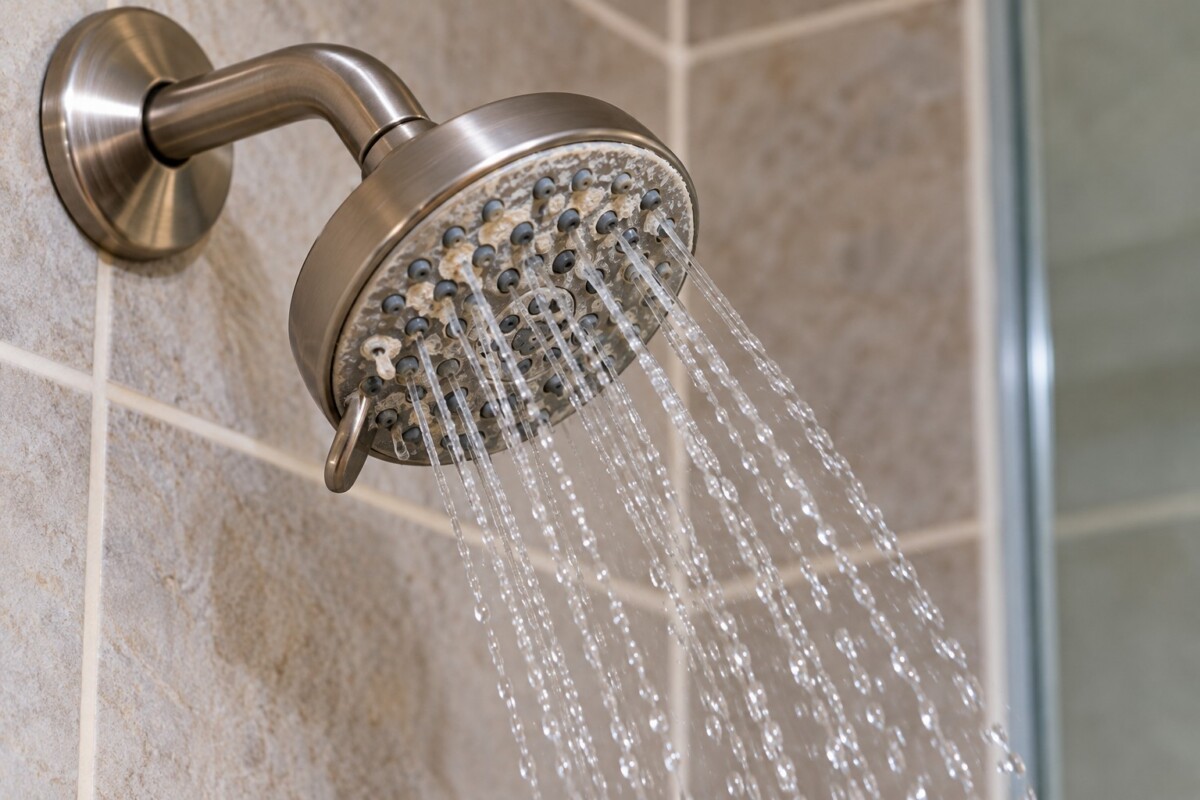
One of the most common causes of reduced shower flow is mineral accumulation inside the showerhead.
As water passes through the showerhead, minerals such as calcium can gradually accumulate around the spray openings and internal passages.
Over time, these deposits can restrict water flow and cause an uneven spray pattern.
Common warning signs include:
- Water spraying in different directions.
- Some showerhead openings producing little or no water.
- White or chalky deposits around the spray nozzles.
- A gradual reduction in shower performance.
What homeowners can try: Follow the showerhead manufacturer’s cleaning instructions. Some models allow the spray nozzles or removable components to be cleaned to remove mineral deposits.
Use only cleaning products approved for the showerhead’s finish and materials. Certain chemicals can damage plated finishes, rubber seals, and internal components.
If cleaning doesn’t restore normal flow, the showerhead may need to be replaced.
2. A Clogged or Failing Shower Valve Cartridge
Behind the shower handle is a valve that controls water flow and temperature.
Many modern shower valves use a replaceable cartridge containing internal passages, seals, and moving components.
Over time, mineral deposits, sediment, or worn internal parts can restrict water flow through the cartridge.
Symptoms may include:
- Weak water flow even with a clean showerhead.
- Difficulty adjusting water temperature.
- Water that is much weaker on the hot or cold side.
- A shower handle that becomes difficult to operate.
- A gradual decline in shower performance.
Replacing a shower cartridge may restore proper operation when the cartridge is the cause of the restriction.
However, not every low-flow problem is caused by the cartridge. Proper diagnosis is important before replacing parts.
3. A Problem With the Pressure-Balancing Valve
Many shower valves include a pressure-balancing mechanism designed to help reduce sudden temperature changes when water pressure fluctuates.
For example, when someone flushes a toilet while you’re showering, the pressure-balancing mechanism helps limit an abrupt change in the hot-to-cold water mixture.
If internal components become restricted, worn, or stuck, the valve may not operate correctly.
Depending on the valve design, this can affect water delivery or temperature control.
Important: Shower valves contain components designed to protect against scalding. Never bypass or disable a pressure-balancing or temperature-limiting safety feature to increase water flow.
4. A Partially Closed Water Supply Valve
Sometimes low shower pressure is caused by a water supply valve that isn’t fully open.
This may happen after plumbing repairs, remodeling work, or water service maintenance.
Some shower valves also have integral service stops that allow the hot and cold water supplies to be isolated for maintenance.
If one of these stops is partially closed, water flow through the shower valve may be reduced.
What to check: If the problem began immediately after plumbing work, mention that to your plumber. A partially closed valve or service stop may be responsible.
Do not force old or corroded shutoff valves, and do not remove shower trim to access concealed components unless you’re familiar with the installation.
5. Aging Galvanized Water Piping
Older homes sometimes contain galvanized steel water supply piping.
Over many years, corrosion and mineral deposits can accumulate inside these pipes, reducing their internal diameter.
Even when water pressure appears normal while no fixtures are running, the restricted piping may not deliver enough water when the shower is in use.
Possible signs include:
- Weak flow at multiple plumbing fixtures.
- Pressure dropping significantly when two fixtures operate together.
- Discolored water, especially after periods of inactivity.
- Visible galvanized piping in a crawl space or utility area.
Replacing a showerhead will not correct severely restricted supply piping.
In homes with deteriorated galvanized water lines, repiping may be the most practical long-term solution.
6. A Failing Water Pressure Regulator
Some homes connected to municipal water systems have a pressure-reducing valve, often called a PRV or water pressure regulator.
This device helps maintain appropriate water pressure inside the home when incoming municipal pressure is higher than desired.
If a regulator malfunctions or becomes restricted, homeowners may notice low or inconsistent water pressure.
Common symptoms include:
- Reduced flow at several fixtures.
- Water pressure that changes noticeably during use.
- Pressure dropping when multiple fixtures are operating.
- A problem affecting the entire house rather than one shower.
A pressure gauge can help evaluate water pressure, but diagnosing a regulator may also require checking pressure while water is flowing.
Important: Increasing regulator pressure without identifying the cause of a flow restriction can create additional plumbing problems. Excessive water pressure can damage fixtures, appliances, and supply connections.
7. A Restriction in the Hot Water Supply
If your shower has noticeably less flow when using hot water than when using cold water, the problem may involve the hot water side of the plumbing system.
Possible causes include:
- A partially closed hot water supply valve.
- Sediment or debris restricting a shower cartridge.
- A restriction in the hot water piping.
- A problem with a water heater connection or another component serving the hot water system.
Compare the hot water flow at nearby sinks to help determine whether the problem is isolated to the shower.
If multiple fixtures have poor hot water flow, the problem may be upstream of the shower valve.
8. A Flow-Restricted Showerhead
Modern showerheads are designed to limit water consumption while providing an acceptable shower experience.
Some models deliver a lower flow rate than older showerheads, even when the home’s water pressure is normal.
If your shower pressure seemed weak immediately after installing a new showerhead, its spray design or rated flow may explain the difference.
Before assuming there’s a plumbing problem, check the showerhead’s rated gallons per minute (GPM) and the manufacturer’s specifications.
Important: Do not remove or alter factory-installed flow-control components in a way that violates applicable plumbing requirements or the manufacturer’s instructions.
9. A Water Supply Line Restriction or Hidden Leak
Low water flow may occasionally be caused by a restriction, damaged pipe, or leak somewhere in the water supply system.
For example, a kinked flexible supply connection, accumulated debris, or deteriorated piping may reduce the amount of water reaching a fixture.
A substantial hidden leak can also affect system performance and should be investigated promptly.
Warning signs may include:
- An unexpected increase in your water bill.
- Wet areas in a crawl space or around plumbing connections.
- Unexplained water sounds when fixtures are turned off.
- Low water pressure affecting several areas of the home.
Not every low-pressure problem indicates a leak, but unexplained moisture or water usage deserves attention.
How Can You Determine What’s Causing Low Shower Pressure?
Before calling a plumber, there are several simple observations that can help narrow down the source of the problem.
- Check other faucets. If only the shower has weak flow, the problem is more likely associated with that fixture or its branch piping.
- Compare hot and cold water. If the flow changes noticeably with temperature selection, mention that to your plumber. It may help identify a restriction on one side of the system.
- Inspect the showerhead. Look for mineral deposits, clogged nozzles, or an uneven spray pattern.
- Think about when the problem started. Did the flow decrease gradually, suddenly, or immediately after plumbing work?
- Notice what happens when other fixtures run. A significant drop in shower flow when another faucet operates may indicate a supply or distribution problem.
- Look for visible leaks. Check accessible plumbing areas for moisture, dripping connections, or other signs of water loss.
These observations can help your plumber identify the problem more efficiently.
Should You Replace the Showerhead or Call a Plumber?
If your showerhead has visible mineral deposits and all other fixtures operate normally, cleaning or replacing the showerhead may be a reasonable first step.
However, if the shower continues to have weak flow after the showerhead has been addressed, the restriction may be inside the valve or supply piping.
A professional plumbing inspection is particularly helpful when:
- The shower flow suddenly becomes much weaker.
- Water temperature is difficult to control.
- Several fixtures have low water flow.
- The problem occurs only on the hot or cold side.
- The home contains older galvanized water piping.
- Water pressure drops dramatically when other fixtures operate.
When Should You Call Barry Williams Plumbing?
Low shower pressure can be caused by anything from a clogged showerhead to a deteriorating plumbing system.
The important thing is identifying the actual restriction rather than replacing parts unnecessarily.
Barry Williams Plumbing can help diagnose low shower flow, inspect shower valves and cartridges, evaluate household water pressure, and recommend appropriate plumbing repairs.
Whether the solution involves repairing a shower valve, correcting a water supply problem, or replacing deteriorated piping, our goal is to help restore dependable water flow throughout your home.
Don’t settle for a weak shower. Identifying the cause is the first step toward getting your water flowing properly again.