


Why Do I Get a Cold Water Sandwich in My Shower?
Have you ever been enjoying a hot shower when suddenly the water turns cold for several seconds, then becomes hot again?
It’s an unpleasant surprise, especially when you’re standing directly beneath the showerhead.
This unusual temperature fluctuation is commonly called a cold water sandwich, and it’s a phenomenon that can occur with tankless water heaters.
At Barry Williams Plumbing, we believe understanding how tankless water heaters operate can help homeowners distinguish normal operating characteristics from problems that require professional attention.
Let’s explain what causes a cold water sandwich, why it happens, and what can be done to reduce or eliminate it.
What Is a Cold Water Sandwich?
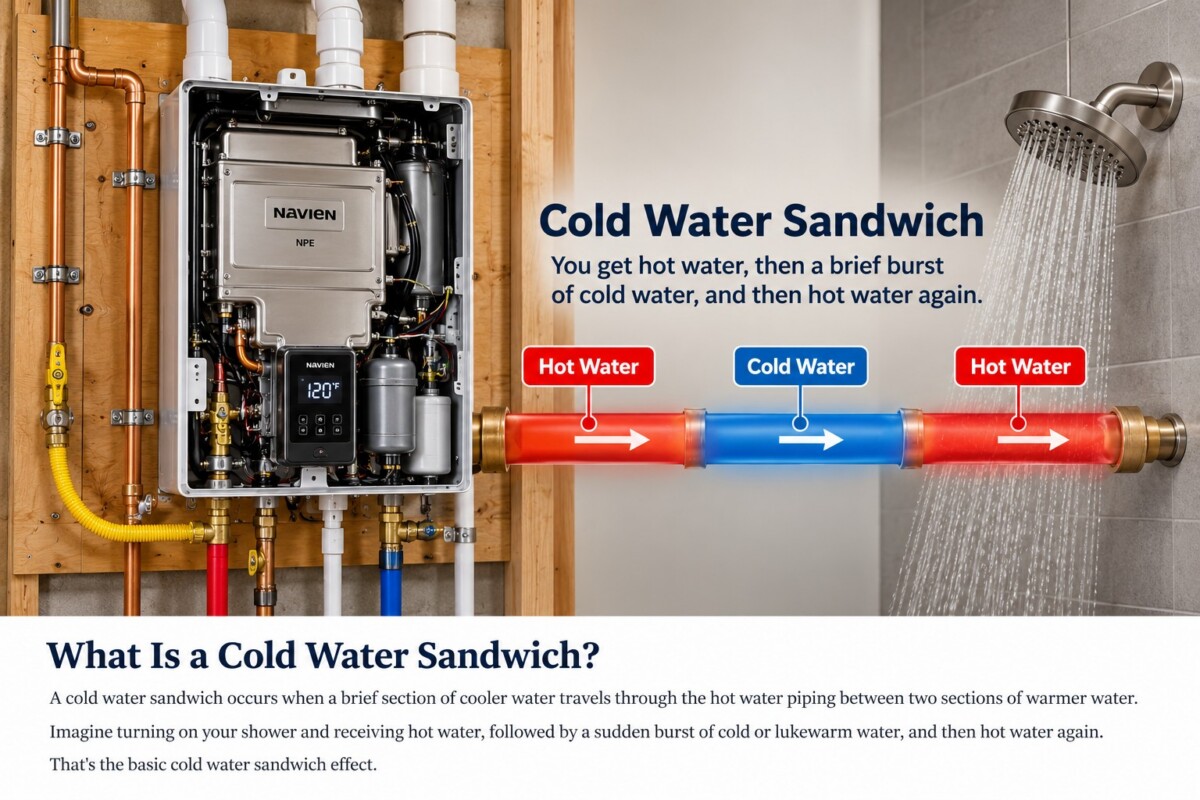
A cold water sandwich occurs when a brief section of cooler water travels through the hot water piping between two sections of warmer water.
Imagine turning on your shower and receiving hot water, followed by a sudden burst of cold or lukewarm water, and then hot water again.
That’s the basic cold water sandwich effect.
It is most commonly associated with tankless water heaters, particularly when hot water is turned off and then restarted after a short period.
Although the temperature change may last only a few seconds, it can be very noticeable while showering.
1. Why Tankless Water Heaters Can Create a Cold Water Sandwich
Unlike traditional tank-type water heaters, tankless water heaters generally heat water as it flows through the unit rather than storing a large supply of heated water.
When you open a hot water faucet, the tankless heater detects water flow and activates its heating system.
However, the burner or electric heating elements do not necessarily reach the required heating output instantaneously.
There can be a brief delay between the start of water flow and the heater delivering water at the selected temperature.
During this startup period, a small volume of cooler water may pass through the unit.
If hot water from a previous operating cycle is already in the piping, the sequence can be:
- Warm water remaining in the hot water piping reaches the shower first.
- A section of cooler water produced during heater startup follows.
- Newly heated water reaches the shower after the heater stabilizes.
That cooler section between two warmer sections is what plumbers call a cold water sandwich.
2. Why It Happens When You Turn the Shower Off and Back On
One of the most common situations occurs when someone turns off the shower briefly and then turns it back on.
For example, you might shut off the water while shampooing your hair or adjusting the showerhead.
When the water stops flowing, the tankless water heater detects the loss of flow and shuts down its heating operation.
When you turn the shower back on, the heater must detect flow and restart the heating process.
Depending on the heater design and operating conditions, this can introduce another brief section of cooler water into the hot water line.
That cooler water eventually reaches the showerhead, even though the heater may already be producing hot water again.
Important: The temperature fluctuation may occur several seconds after restarting the shower because the cooler water must travel through the piping before reaching you.
3. Why the Distance From the Water Heater Matters
The distance between your tankless water heater and the shower can affect how noticeable a cold water sandwich becomes.
Water must travel through the hot water piping before reaching the fixture.
Longer pipe runs contain more water and can delay the arrival of newly heated water.
As a result, the cooler section of water may not reach the shower immediately after the heater restarts.
Instead, you may experience the temperature change after the shower has already been running for a short time.
Pipe size, flow rate, insulation, and plumbing layout can all affect the timing and temperature of water reaching the fixture.
4. Low Water Flow Can Make the Problem Worse
Tankless water heaters require a minimum water flow to activate and continue heating.
Each manufacturer specifies the minimum flow requirements for its equipment.
If water flow drops below the heater’s operating threshold, the heating system may shut off.
When flow increases again, the heater must restart.
This can create additional temperature fluctuations.
Possible contributing factors include:
- Low-flow showerheads.
- Partially closed fixture valves.
- Restricted shower cartridges.
- Mineral buildup in showerheads.
- Operating the shower at a flow rate near the heater’s minimum activation threshold.
If the heater repeatedly starts and stops while the shower is running continuously, the problem may be more than a typical cold water sandwich.
5. A Shower Valve Can Also Cause Temperature Fluctuations
Not every sudden change in shower temperature is caused by the tankless water heater.
A defective shower cartridge, sticking pressure-balancing mechanism, or malfunctioning thermostatic mixing valve can also cause uncomfortable temperature changes.
For example, a pressure-balancing shower valve responds to changes in hot and cold water supply pressure.
If the valve’s internal components are restricted or malfunctioning, the temperature or flow at the shower may become inconsistent.
Here’s an important distinction:
If the temperature problem occurs only at one shower, the shower valve should be considered as a possible cause.
If similar temperature fluctuations occur at several hot water fixtures, the tankless water heater or a shared plumbing component may be responsible.
6. Mineral Buildup Inside the Tankless Water Heater
Tankless water heaters can accumulate mineral deposits inside their heat exchangers, particularly in areas with hard water.
Over time, scale buildup may restrict water flow and interfere with heat transfer.
Depending on the severity, this can contribute to inconsistent hot water performance or heater fault conditions.
Possible warning signs include:
- Reduced hot water flow.
- Temperature fluctuations at multiple fixtures.
- Heater error codes.
- Reduced heating performance.
- Repeated interruptions in hot water delivery.
Descaling and maintenance should be performed according to the water heater manufacturer’s instructions.
However, descaling will not necessarily eliminate a normal cold water sandwich caused by heater startup delay.
7. Can a Hot Water Recirculation System Help?
Some tankless water heater systems use hot water recirculation to reduce the time required for hot water to reach distant fixtures.
A recirculation system moves heated water through designated piping so hot water is available closer to the fixture.
Depending on the equipment and installation, recirculation may also reduce some noticeable temperature fluctuations associated with heater startup.
However, not every recirculation system eliminates cold water sandwiches.
The results depend on the heater design, controls, piping arrangement, and whether the system uses a dedicated return line or another approved configuration.
Important: A recirculation system must be compatible with the tankless heater and installed according to the manufacturer’s requirements.
8. Do Tankless Water Heaters With Built-In Storage Help?
Some tankless water heaters incorporate a small internal storage or buffer tank designed to improve hot water delivery.
These systems can help reduce the effects of startup delays by providing a small amount of heated water while the main heating system activates.
Other models use specialized controls or recirculation features to improve temperature consistency.
These features can reduce cold water sandwich complaints, although performance varies by model and installation.
Not all tankless water heaters include these features.
9. Is a Cold Water Sandwich Normal?
A brief temperature fluctuation after restarting hot water can be a normal operating characteristic of certain tankless water heaters.
However, repeated or severe temperature changes during continuous shower use should not automatically be considered normal.
Warning signs that deserve further investigation include:
- The shower repeatedly alternates between hot and cold without being turned off.
- Hot water disappears for extended periods.
- The heater frequently shuts down during normal use.
- Error codes appear on the water heater.
- Hot water flow has noticeably decreased.
- The problem is becoming progressively worse.
These symptoms may indicate a flow problem, malfunctioning heater component, restricted heat exchanger, or shower valve issue.
10. How Can You Tell What’s Causing the Problem?
Before calling a plumber, there are several observations that may help narrow down the cause.
- Notice when the cold water occurs. Does it happen after turning the shower off and back on, or during continuous operation?
- Check other fixtures. Do you experience similar temperature fluctuations at bathroom sinks or kitchen faucets?
- Observe the heater. If your tankless heater has a display, check whether it shows an error code when the problem occurs.
- Consider the shower flow rate. Very low water flow may contribute to heater activation problems.
- Think about maintenance. Has the tankless water heater been serviced according to the manufacturer’s recommendations?
- Consider the shower valve. If the problem occurs at only one shower, the cartridge or balancing mechanism may be involved.
These observations can help a plumbing professional distinguish a normal startup delay from a system malfunction.
Can You Eliminate a Cold Water Sandwich?
Depending on the water heater and plumbing system, several approaches may help reduce the problem.
- Verifying that the heater is operating within its specified flow range.
- Correcting restrictions in showerheads, valves, or piping.
- Servicing the tankless water heater when maintenance is needed.
- Repairing a defective shower valve.
- Evaluating compatible recirculation or buffer-tank solutions.
- Considering equipment with features designed to improve temperature stability when replacement is appropriate.
The best solution depends on whether the temperature change is caused by normal heater startup behavior or an underlying plumbing problem.
Simply increasing the water heater’s temperature setting is not a reliable solution and may increase the risk of scalding.
When Should You Call a Plumber?
If your shower repeatedly turns cold during continuous use, the temperature fluctuations are severe, or your tankless water heater displays error codes, a professional inspection is recommended.
A qualified plumber can evaluate water flow, inspect shower valve components, review heater operating conditions, and determine whether maintenance or repairs are needed.
When Should You Call Barry Williams Plumbing?
A cold water sandwich can be an uncomfortable surprise, but it doesn’t always mean your tankless water heater is failing.
Sometimes the problem is simply related to how the heater starts and stops. Other times, restricted water flow, a defective shower valve, or a heater performance issue may be responsible.
Barry Williams Plumbing can help diagnose inconsistent hot water, evaluate tankless water heater performance, inspect shower valves, and recommend appropriate plumbing repairs or improvements.
Understanding why your shower suddenly turns cold is the first step toward enjoying more consistent, comfortable hot water.