


NAECA: What Is It, and How Will It Affect Your Water Heater?
If you have replaced a water heater in the past several years,
you may have noticed that newer models are larger, more
efficient, and sometimes more expensive. Federal
energy-efficiency regulations are one reason why.
Another major change is scheduled for 2029.
Understanding these regulations can help homeowners
make informed decisions when it’s time to replace
their water heater.
What Is NAECA?
NAECA stands for the National Appliance Energy
Conservation Act. Enacted in 1987, this federal law
established minimum energy-efficiency standards for many
household appliances, including residential water heaters.
The purpose is to reduce energy consumption and operating
costs by requiring newly manufactured appliances to meet
minimum efficiency standards.
Over the years, these standards have been updated as
water-heating technology has improved.
What Changed in 2015?
On April 16, 2015, updated federal water-heater
efficiency standards took effect.
For many homeowners, one of the most noticeable changes
was the physical size of replacement water heaters.
Manufacturers improved insulation and made other design
changes to meet the higher efficiency requirements.
As a result, some replacement tanks became taller
or wider than the units they replaced.
This created challenges in closets, attics, and other
tight spaces where older water heaters had been installed.
What Happened to 80-Gallon Electric Water Heaters?
Large conventional electric resistance water heaters
were particularly affected by the 2015 standards.
Many traditional 80-gallon residential models were
replaced in manufacturers’ product lines by more
efficient heat-pump designs.
In some installations, contractors explored
light-commercial equipment or alternative residential
systems, depending on the application and applicable
requirements.
The lesson for homeowners was simple: replacing a water
heater was no longer always a matter of installing an
identical tank in the same space.
What’s Changing in 2029?
Another round of federal efficiency standards for
residential water heaters is scheduled to take effect
on May 6, 2029.
These requirements apply to newly manufactured
equipment covered by the regulations.
They do not require homeowners to remove existing,
functioning water heaters.
Electric Tank Water Heaters
The biggest changes will affect conventional electric
resistance tank water heaters.
Many traditional electric storage models, including
common 40- and 50-gallon sizes, will not meet the new
efficiency levels using conventional electric resistance
heating alone.
Heat-pump water heaters, also called hybrid electric
water heaters, are expected to become an increasingly
important replacement option.
Gas Tank Water Heaters
Gas storage water heaters are also subject to updated
efficiency standards. However, the 2029 rule does not
eliminate every conventional 40- or 50-gallon gas
tank water heater.
Homeowners will still need to compare available
equipment based on efficiency, installation requirements,
fuel type, and hot-water demand.
every tank water heater is being banned. The requirements
differ between electric and gas models, and existing
installed water heaters can continue to be used.
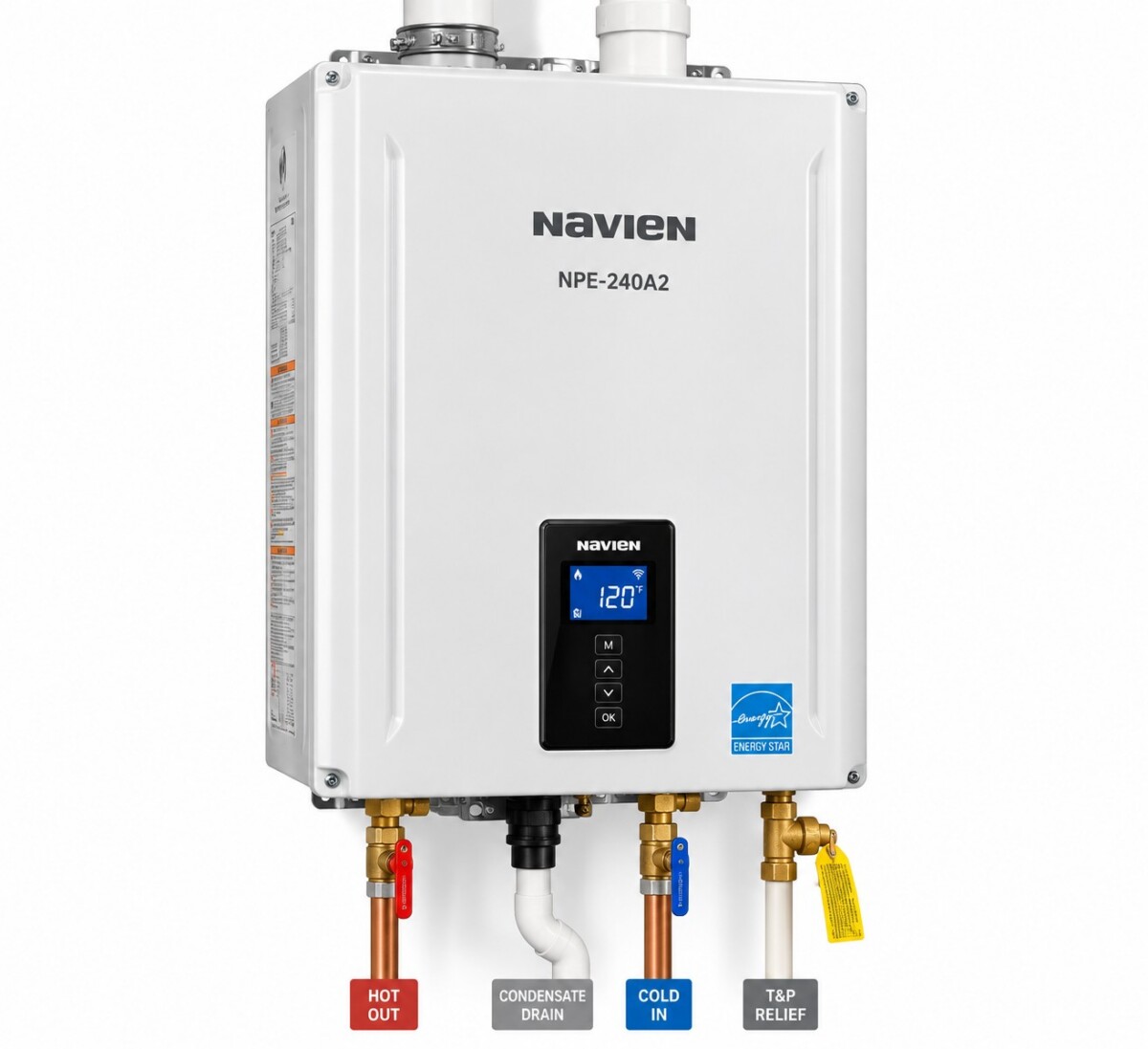
Option 1: Condensing Tankless Water Heaters
One alternative worth considering is a high-efficiency
condensing tankless water heater, such as models
manufactured by Navien.
Unlike a conventional storage tank, a tankless water
heater heats water as it flows through the unit.
It does not continuously maintain a large tank
of stored hot water.
Potential Advantages
- Continuous hot water when properly sized for demand.
- High energy efficiency, particularly with condensing models.
- Compact, wall-mounted installation saves floor space.
- No large storage tank holding 40 or 50 gallons of water.
Things to Consider
- Higher initial installation costs may apply.
- Gas supply, venting, condensate drainage, and electrical requirements must be evaluated.
- Periodic maintenance, including descaling when needed, is important.
- The system must be properly sized for simultaneous hot-water use.
Tankless systems can be an excellent choice for many
homes, but they are not necessarily the most economical
option for every installation.
Option 2: Hybrid Heat-Pump Water Heaters
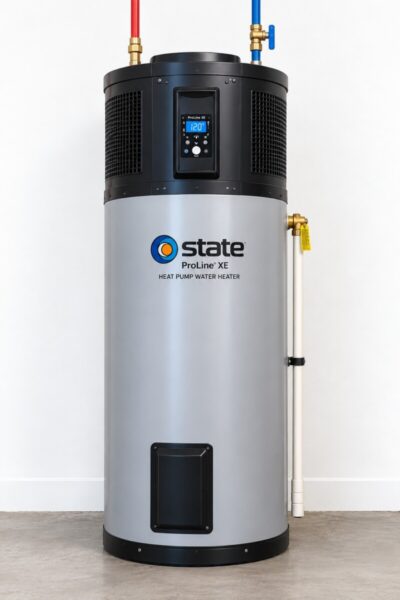
Another increasingly popular option is the hybrid
electric heat-pump water heater, including models
manufactured by State Water Heaters.
Rather than relying primarily on electric resistance
heating, a heat-pump water heater transfers heat
from the surrounding air into the stored water.
This process can use substantially less electricity
than a conventional electric tank water heater
under suitable conditions.
Potential Advantages
- Significantly lower electricity consumption compared with many conventional electric resistance tanks.
- Stored hot water remains available for household use.
- Some models offer multiple operating modes.
- May qualify for available energy-efficiency incentives, depending on the product and program.
Things to Consider
- Requires adequate installation space and airflow.
- Produces some noise while operating.
- Cools and dehumidifies the surrounding air.
- Condensate drainage is required.
- Installation conditions affect efficiency and performance.
For homes currently using conventional electric tank
water heaters, hybrid heat-pump technology may be
a practical long-term solution.
Should You Replace Your Water Heater Before 2029?
Not necessarily. If your existing water
heater is operating safely and reliably, there is
no federal requirement to replace it simply because
new efficiency standards are approaching.
However, if your water heater is already approaching
the end of its useful life, planning ahead makes sense.
Many conventional tank water heaters have an expected
service life of approximately 10 to 12 years,
although actual lifespan varies with water quality,
maintenance, installation conditions, and usage.
Before choosing a replacement, consider:
- The age and condition of your current water heater.
- Whether your home uses natural gas, propane, or electricity.
- Your family’s hot-water demand.
- Available installation space.
- Initial installation costs versus long-term operating costs.
- Maintenance requirements and equipment warranties.
What About Water Heater Prices?
New efficiency requirements can affect equipment
costs and product availability as manufacturers
change their product lines.
However, future prices will also depend on manufacturing
costs, supply, demand, and market conditions.
There is no guarantee that every conventional tank
water heater will become more expensive as
2029 approaches.
Homeowners are better served by evaluating their
options before an emergency replacement becomes necessary.
Questions About Your Next Water Heater?
At Barry Williams Plumbing Co., we help homeowners
understand their water-heating options, from conventional
storage tanks to high-efficiency tankless and hybrid systems.
If your water heater is aging or you’re considering
an upgrade, contact us to arrange a free in-home
consultation and discuss which system best fits your home.
Barry Williams Plumbing Co.
Learn more:
U.S. Department of Energy — Consumer Water Heaters